Blog Post
From Retrieval to Trust: How Enterprise RAG Evolves in Production

At 2:17 a.m., a production alert fires. Error ERR-4291 is affecting a customer-facing service, and engineers cannot bring the system back online. A software engineer asks an internal assistant, “What is the approved response for ERR-4291?” The answer arrives immediately: restart the service. It cites a runbook and a past incident. Both look plausible. But the runbook is two versions old, the past incident was a different environment, and the latest deployment note was never indexed. The model did not invent an answer; it assembled one from evidence that was incomplete, stale, and insufficiently scoped.
That is the production RAG problem in one exchange. Retrieval-augmented generation (RAG) gives a model relevant internal evidence before it answers. It is useful, but it is not one fixed architecture.
This post follows five representative patterns: Traditional RAG, Hybrid RAG, GraphRAG, Agentic RAG, and Corrective RAG. They are not the only patterns, and they are not a mandatory maturity ladder. Each solves a different evidence failure.
What RAG Actually Does
RAG gives a language model a small, relevant set of enterprise knowledge at question time. Instead of asking the model to remember every policy, runbook, and decision, it finds the evidence first and asks the model to answer from it. Take the opening question: “What is the approved response for ERR-4291?” A basic RAG system should work through it like this:
1. Start with trusted sources
The approved runbook, past incident record, and deployment note enter the knowledge base with their owner, date, and access rules.
2. Break them into chunks
Chunking splits each document into meaningful sections. The ERR-4291 recovery steps and their conditions stay together as one retrievable piece.
3. Create embeddings
An embedding turns that chunk's meaning into numbers, helping the system recognize related ERR-4291 failures and recovery guidance.
4. Retrieve evidence
When the question arrives, the system finds the ERR-4291 runbook section, the latest deployment note, and the current service owner.
5. Answer with context
The model is instructed to answer from those sources and cite them, so the response can be traced back to real evidence rather than memory.
Why Basic RAG Breaks in Production
Basic RAG can fail quietly. It may return a real document and a fluent answer while still missing the current policy, the decisive table row, or the exception that changes the outcome. The trouble often starts before retrieval: PDFs can lose headings and tables during parsing; poor chunking can separate a rule from its exception; and too much chunk overlap creates near-duplicate results. Metadata such as owner, effective date, region, version, and access label gives a retrieved chunk the context it needs.
Retrieval has limits too. Sources, permissions, and question patterns drift over time, so teams need to measure parsing, retrieval, ranking, and answer quality separately rather than trusting a single end-to-end score.
Where a basic pipeline breaks
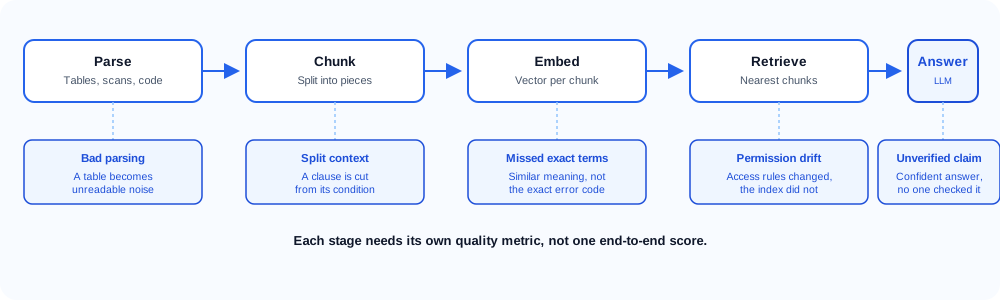
The Progression From Retrieval to Trust
The useful question is not, “Which RAG architecture is best?” It is, “What evidence failure are we trying to remove?”
Traditional RAG: Start With the Knowledge You Already Have
This is the kind of question Traditional RAG handles well: the answer already lives in a runbook. Before anyone asks, it breaks the runbook into useful sections, creates embeddings for those sections, and stores them in a searchable index. When the question arrives, it finds the closest chunks and gives them to the model. The model is no longer answering from memory alone; it is answering with the runbook in front of it.
Traditional RAG: index once, retrieve on every query
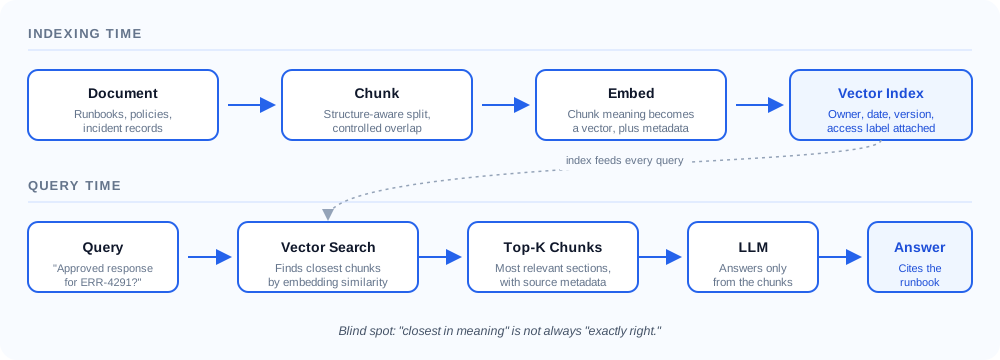
The blind spot
This is simple and powerful. But it has a blind spot: “closest in meaning” is not always “exactly right.” A specific error code or policy clause can disappear behind a more generally similar document.
Hybrid RAG: When One Search Method Is Not Enough
Now change the question: “Does ERR-4291 require a restart or a rollback?” The exact error code matters. Traditional vector search may understand the topic, but it can still miss the specific code or recovery instruction. Hybrid RAG uses two searches at once: vector search looks for similar meaning, while keyword search, often using BM25, looks for exact words and identifiers. The system combines both result sets, applies filters such as document date or access level, and uses a reranker to put the strongest evidence first.
Hybrid RAG: two searches, fused and reranked
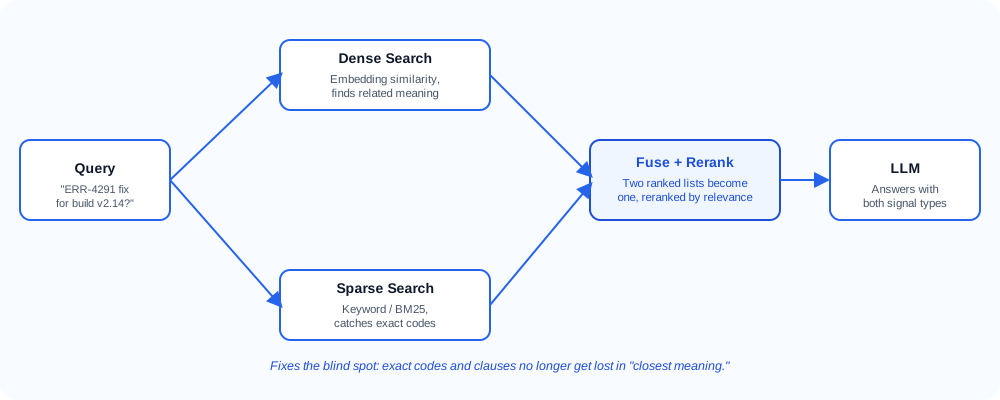
What's still missing
Hybrid RAG solves many real enterprise search problems. But it still sees information as separate passages. It struggles when the answer is hidden in the relationship between several systems, people, changes, and policies.
GraphRAG: When the Answer Is in the Connections
Consider a harder question: “Which recent change affected this service, and who owns it?” No single document holds the answer. GraphRAG adds a map of the enterprise. It identifies things such as services, owners, dependencies, incidents, and changes. These are called entities. It then records how they relate: this team owns that service; this change affected that dependency; that dependency contributed to this incident.
GraphRAG: traverse relationships, then retrieve the source
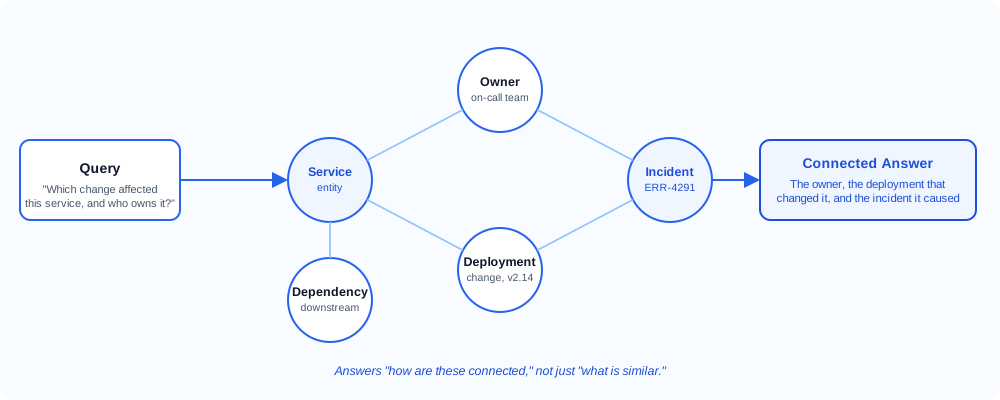
Where it helps, and where it doesn't
The system can follow those links, or multi-hop paths, and retrieve the source documents behind them. The graph helps connect the evidence; the documents still prove it. This is useful when those relationships are stable and important. It is unnecessary when one good document answers the question. Microsoft Research’s GraphRAG paper covers the underlying approach: building a knowledge graph from source documents, then using it to answer questions a single passage cannot.
Agentic RAG: When the System Needs to Investigate
Some questions cannot be answered from a prepared index or graph alone. During an operational issue, the system may need a current runbook, live service ownership, the latest deployment, a policy exception, and the state of the affected environment. Agentic RAG lets the system work through the question step by step: decide what to check first, select the right source or tool, read the result, and use it to choose the next step. This is routing and iterative retrieval: search, learn, then search again with better context. Carrying that context across steps, and across sessions, needs deliberate memory design, not an ever-growing prompt; I covered that in Why AI Agents Forget: How to Design Memory That Works.
Agentic RAG: plan, retrieve, evaluate, repeat
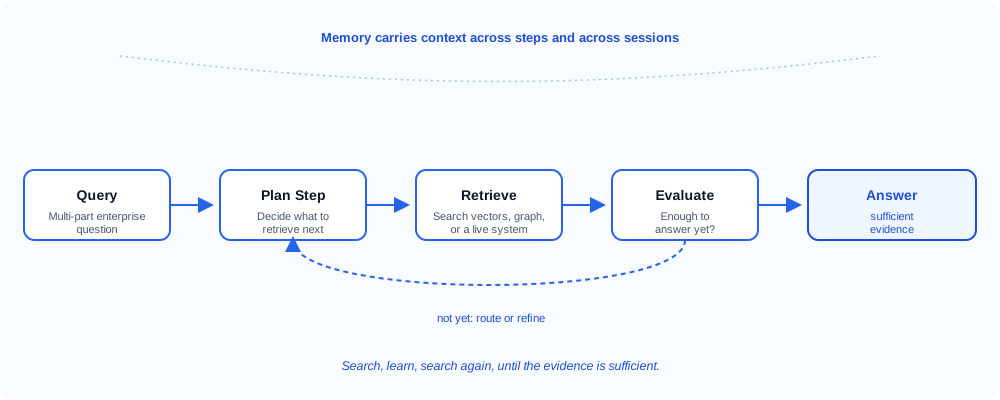
Keeping investigation bounded
That is useful, but it needs boundaries. Tool access, timeouts, retry limits, cost limits, and clear stop conditions keep an investigation from becoming an expensive or unsafe loop. The Pattern Language of Enterprise Agentic Workflows explores those same controls.
Corrective RAG: When the Answer Must Be Checked Before It Is Trusted
Even a careful investigation can end with weak evidence: a stale runbook, conflicting policies, or sources that answer only part of the question. A confident answer is still not proof. Corrective RAG adds a checkpoint before the response reaches the user. It asks whether the evidence is relevant, current, sufficient, and consistent. Groundedness checks whether the answer is supported by the retrieved sources. Citation validation checks whether the cited source actually supports the claim.
Corrective RAG: grade the answer before it ships
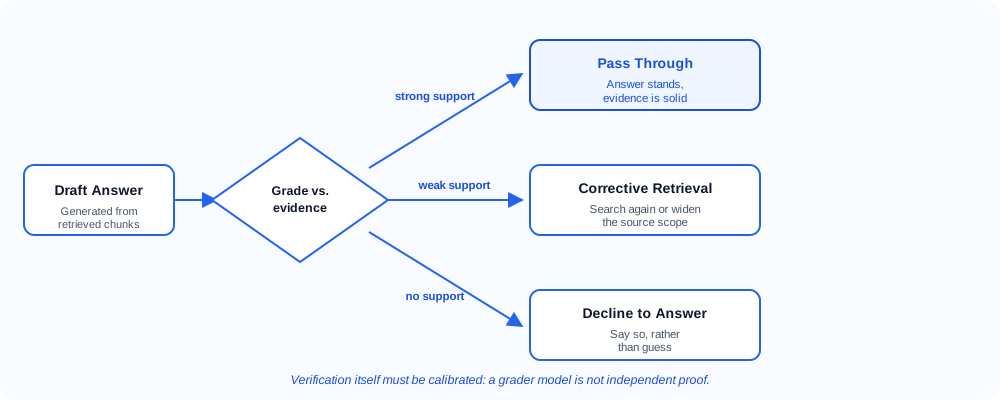
When evidence falls short
When the evidence is weak, the system can retrieve again, choose another source, answer with a clear limitation, or escalate to a person. Corrective RAG can sit on top of any of the earlier patterns. It is not the final destination; it is the point where the system learns that not answering is sometimes the safest answer. This grading step is the core idea behind the CRAG paper: a lightweight evaluator scores retrieved evidence and triggers a different action depending on the result. One caution: verification has to be calibrated on its own, since a model grading another model’s answer is not independent proof that the answer is right.
The Production Layer Beneath Every Pattern
Architecture diagrams show the path from question to answer. Production trust comes from the layer underneath: the controls that would have caught the ERR-4291 runbook that was two versions old before an engineer ever trusted it.
Evaluation and drift
Test with real and adversarial questions, not just the easy ones. Track retrieval accuracy and answer groundedness as separate numbers, then segment both by source and time. A single blended score will not show a corpus drifting stale.
Access and auditability
Enforce identity-aware access filters before retrieval, and make sure those permissions survive into every cache and derived index. Log enough to reconstruct why an answer was given, without turning that log into a new place sensitive data leaks from.
Cost and latency
Set a budget for how much retrieval, reranking, and tool use a single question is allowed to trigger. Measure tail latency, not just the average, and cache only where freshness and access rules can still be enforced correctly.
Versioning and freshness
Carry each document's version and effective date into retrieval, the way a runbook that was two versions old should have been flagged rather than served as current. Define re-indexing SLAs, and for time-sensitive questions, fail clearly rather than answer from a source of unknown age.
Evaluate each layer separately: parsing and metadata, retrieval recall, ranking position, grounded answers, and then the end-to-end experience. A strong final answer can hide a weak retrieval process that happened to get lucky. Tie metrics to consequence: a missed citation in a low-risk FAQ is not the same failure as incorrect operational guidance during an incident.
Choosing the Right Level of RAG
Choose the least complex pattern that meets the trust requirement. Add complexity only when it removes a measured failure worth the extra cost, latency, and governance.
| Pattern | Use it when | Signal to move here |
|---|---|---|
| Traditional RAG | Most answers come from a curated source set and one or two documents hold the needed evidence. | Recall and citation support already meet target, at acceptable latency. |
| Hybrid RAG | Queries mix natural language with exact identifiers, clauses, names, or domain terms. | Evaluation shows vector-only retrieval misses or under-ranks exact terms. |
| GraphRAG | Recurring questions depend on entities, dependencies, ownership, chronology, or multi-hop relationships. | Facts are found but can't be connected reliably from passages alone. |
| Agentic RAG | The system must plan across sources or tools, refine retrieval from intermediate results, or investigate changing state. | One-pass retrieval fails on a defined class of multi-source questions. |
| Corrective RAG | Weak, conflicting, stale, or incomplete evidence must cause retry, abstention, fallback, or human review. | An unsupported answer costs more than the added verification. |
Add each pattern one at a time, in response to a specific measured failure, rather than all at once. That keeps diagnosis possible: when everything arrives at once, teams cannot tell whether a change improved parsing, retrieval, graph traversal, tool use, or answer verification.
Closing Thought
Production RAG is not a document-upload feature. It is an evidence system. A model is only as trustworthy as the sources it can see, the retrieval decisions that assemble them, and the controls that decide when evidence is not good enough.
- Traditional RAG retrieves.
- Hybrid RAG improves recall.
- GraphRAG connects evidence.
- Agentic RAG investigates.
- Corrective RAG verifies.
The goal is not to reach the last pattern. The goal is to know which evidence failure stands between a plausible answer and a trustworthy one, then solve that problem with the least architecture necessary.